

For decades, tactical performance has largely been developed through separate training disciplines.
Physical instructors build strength, endurance, and resilience. Marksmanship instructors focus on weapon handling. Tactical trainers develop procedures and communication. Psychologists address stress management and mental resilience.
Each discipline contributes to operational effectiveness. Yet operational performance does not occur in separate domains.
Operations happen when physical fatigue, cognitive load, time pressure, uncertainty, and communication demands interact simultaneously.
This is where Human Performance Optimization becomes relevant.
Readiness Is More Than Physical Preparation
Physical fitness remains a fundamental requirement for military and law enforcement personnel. Operators carry significant loads, work under prolonged stress, and are expected to make decisions in environments where mistakes have consequences.
However, physical capability alone does not determine performance.
An operator may possess excellent strength and endurance while still struggling with threat discrimination, prioritisation, communication, or decision-making under pressure. Equally, highly capable decision-makers can see their performance deteriorate when fatigue begins to affect attention, working memory, and judgement.
Operational readiness therefore extends beyond fitness. It includes the ability to maintain decision quality when physical and cognitive demands increase simultaneously.
The Limitation of Isolated Training
Most training systems still evaluate physical and cognitive performance separately.
Physical assessments measure variables such as strength, aerobic capacity, body composition, and endurance. Tactical evaluations often focus on procedural correctness, marksmanship, or mission outcomes. Cognitive assessments, where they exist, are frequently conducted in controlled environments detached from operational tasks.
The result is a transfer gap.
Performance is measured in isolation, while operational demands are experienced as an integrated system.
This creates a blind spot for instructors and commanders. They may know how an operator performs when fresh. They may know how an operator performs physically. What is often less visible is how judgement changes when fatigue accumulates.
Fatigue Influences Decision-Making
Physical fatigue affects more than muscles.
Research has consistently demonstrated that increasing physiological stress influences attention, reaction speed, working memory, situational awareness, and decision-making quality. The challenge is not simply that operators become slower. The challenge is that they may become less accurate while remaining confident in their decisions.
From a readiness perspective, this distinction matters.
The objective is not to identify who becomes tired. Every operator becomes tired.
The objective is to understand what fatigue does to judgement.
Profiling Before Programming
Effective Human Performance Optimization begins with understanding the individual operator.
Elite tactical units increasingly use profiling approaches that combine physiological, physical, role-specific, and cognitive assessments. These profiles provide a more complete understanding of strengths, weaknesses, and training priorities.
A comprehensive profile may include:
- Bioenergetic characteristics such as aerobic and anaerobic capacity.
- Biodynamic characteristics such as strength, power, movement quality, and load-bearing capability.
- Position-specific requirements linked to operational roles.
- Cognitive characteristics including decision speed, attention control, stress resilience, and situational awareness.
Without profiling, training remains largely based on assumptions. With profiling, training can be targeted to the individual rather than the average.
Integrating Physical and Cognitive Training
The most relevant development in Human Performance Optimization is not the addition of another assessment tool.
It is the integration of physical and cognitive systems.
A practical example is the combination of physical preload and decision training.
An operator first performs a defined physical task designed to create measurable physiological stress. This may involve repeated sprints, strength circuits, load carriage, or other operationally relevant activities.
Immediately afterwards, the operator enters a decision-making scenario.
The objective is not to create exhaustion. The objective is to expose how judgement, communication, prioritisation, and threat discrimination change when physiological stress is present.
This creates training conditions that are closer to operational reality than either physical training or cognitive training alone.
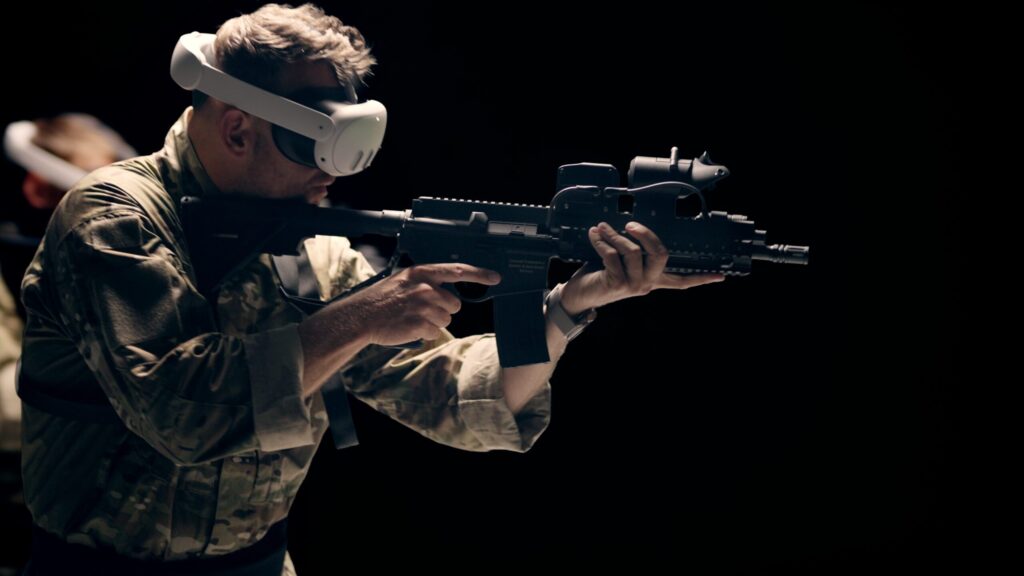
The Role of Immersion
Virtual reality is often discussed as a technology.
A more useful perspective is to view it as a training environment.
Its value lies in providing repeatable decision scenarios, controlled exposure to cognitive stressors, structured assessment opportunities, and measurable outcomes. It allows instructors to expose personnel to situations that would otherwise be difficult, expensive, or impractical to repeat at scale.
This does not make virtual reality a replacement for live training.
Live-fire exercises, force-on-force training, tactical medicine, and field exercises remain essential components of preparation.
When used appropriately, it becomes another component of a broader readiness architecture.
Measuring What Matters
Any Human Performance Optimization programme depends on assessment.
Measurement must extend beyond physical outputs and physiological signals. Behavioural performance remains central.
Useful indicators include decision quality, reaction latency, communication effectiveness, scenario outcomes, and physiological responses such as heart rate variability. These measures become valuable when combined with structured observation and after-action review processes.
Technology can support assessment.
It cannot replace professional evaluation.
The goal is not the collection of more data. The goal is a better understanding of operational performance.
From Training Events to Training Systems
Human Performance Optimization is often discussed as a collection of interventions.
The more useful perspective is to treat it as a system.
Physical preparation, cognitive performance, recovery, profiling, assessment, and tactical training are interconnected components of the same readiness problem.
The units that gain the greatest advantage are unlikely to be those with the most technology.
They will be the organisations that understand how these components interact and build training systems that reflect operational reality.
Readiness is not determined by how operators perform when conditions are ideal.
Readiness becomes visible when physical fatigue, cognitive load, and operational pressure begin to compete for attention, and sound decisions follow.
 This article accompanies the keynote presented by Human Performance Optimization specialist Jonas Schaerk at the Tactical Performance Conference in Savannah, USA, on 16 June 2026.
Download the presentation deck here.