
Readiness infrastructure
Shoot, move, communicate, stearing and defending against drones in the last line of defense. Ukrainian units must sustain foundational skills while adapting to constant changing tactics and threats.
Our platform lets warfighter train, and prepare operations. Carried in a bag, battery-operated and ready for use within five minutes of unpacking, the kit allows personnel to train without dedicated facilities. The unit can make use of the full range to gain and sustain skill – as individual in down time, or training in formation in the same immersive scenario.
The value of variation and relevance for high stake tasks, for instance Force-on-Force options in different modules has direct relevance for the ones in deployment. Training against a responsive opposing force introduces the uncertainty and pressure of an adversary, and the ability to vary opposing-force positions and behaviour allows units to rehearse tactical situations and different responses in preparation. In imminent context to upcoming operations.
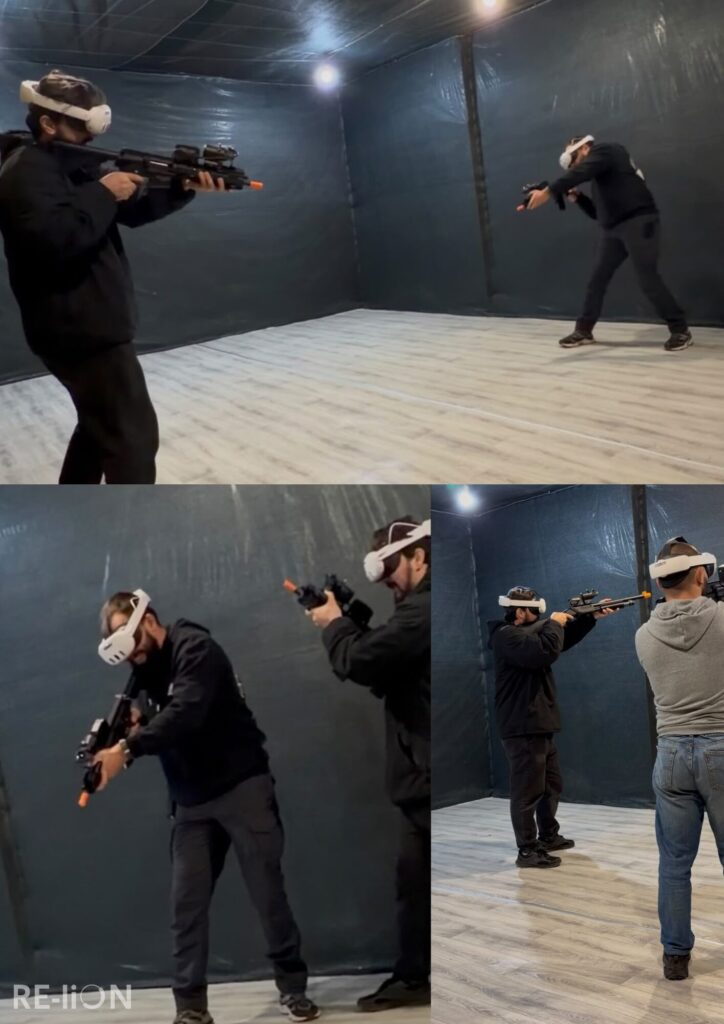
Coming to the operational track of the platform: Bringing a planning team together takes time, and in active conflicts, concentrating personnel in one location creates a security risk.
Enhancing the planning phase allows teams to enter an immersive 3D representation of a previously captured operational environment. Teams can examine terrain and structures at real-world scale, assess approaches and rehearse movements before execution.
Unlike a 3D map viewed on a flat screen, immersion places participants within the environment, allowing them to develop a spatial understanding of the ground and discuss their plans from the perspective of those who will execute them.
Back to the safety aspect, collaborative planning enables personnel to prepare an operation from separate locations, reducing both the time needed to assemble the team and unnecessary exposure.
Learning from deployed systems
It is discussed excessively: By the time a requirement reaches a supplier, the original problem has often passed through several organisational layers – translation issues, information latency or a lack of urgency are all resulting in peacetime roadmaps.
Not for us, because the direct talk and collaborative development with service members give us the context behind what is happening, why existing solutions fall short and what will make a practical difference.
These exchanges forces us to understand and act on what moves the needle most, next.