
Training closer to where warfighters is already happening under very different conditions.
During Operation Althea, the Operator Kit was used at a Forward Operating Base, turning genuine operational downtime into training time.
In Ukraine, warfighters are training close to the front line, including in basements and air raid shelters, because access to fixed training centres is limited and those centres can themselves become targets.
Two very different environments, but the same principle: training does not always need to start with moving people to dedicated training infrastructure.
The next step is to scale what has worked elsewhere.
Over the past months, our conversations with armies across Europe have repeatedly come back to training capacity. Personnel is expected to grow, but instructor capacity and training infrastructure cannot be expanded at the same pace.
By the mid-2030s, the German Federal Armed Forces plans to grow from roughly 186,700 active soldiers today to 260,000 active plus 200,000 reservists: 460,000 in total. Recruiting is already turning around. But throughput is the problem: fixed instructors, fixed range slots, fixed cycle time, a pipe that doesn’t get wider just because more people are entering it.
RE-liON’s answer starts with the footprint most units already have. A training lane needs 1m × 2m per person: a corner of a barracks room, a classroom, a corridor. No range. No new construction.
Shift from “centralised training by default” to “decentralised unless.”
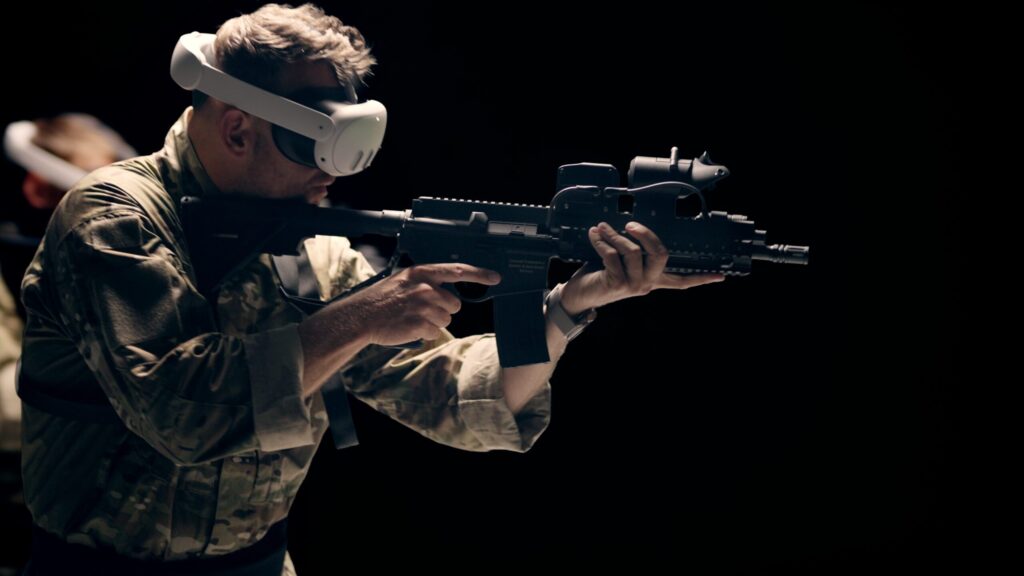
It continues with instructor time. Automating the fundamentals removes part of the day that was never really teaching, so one instructor can guide roughly 2.5× the trainees on the basics, and spend the time saved on the coaching only a person can give.
More repetitions only matter if they’re the right repetitions. On-demand access enables short, frequent training sessions instead of infrequent range weeks. It’s the same logic behind spaced repetition in any skill that decays without practice.
Every session also generates objective performance data, offloaded whenever there’s connectivity. Analysed at force-wide level, that data surfaces lessons that can be encoded directly into the next software update and pushed back to the field: a curriculum that improves continuously, not once every few years.
A warfighter should be able to receive an updated skill pack every six to eight weeks to keep up with changes in technology, threats, tactics and lessons identified.
First close the loop, then speed it up.
This spans foundational warfighter skills through small-unit level: shoot, including counter-UAS; move; communicate; and soon medicate and drone piloting.
This is what capability-as-a-service can enable: a continuous loop for building, updating and sustaining readiness.
And it is available off-the-shelf today, under a yearly service model. You can start now, instead of spending a year writing a program of requirements.
This artice accompanies the keynote at the Training & Education Conference of the German Federal Armed Forces in Hamburg at Sept, at 1st, 2026. “Rebuilding the Infrastructure of Readiness”
Download here