
Training closer to where warfighters is already happening under very different conditions. In Operation Althea, the Operator Kit was used at a Forward Operating Base, turning genuine operational downtime into training time.
In Ukraine, warfighters need to adapt close to the front line, and use any existing infrastructure for that available: basements, air raid shelters, etc., because access to fixed training centres is limited and those centres can themselves become targets.
Two very different environments, but the same principle: training does not always need to start with moving people to the training infrastructure. Our next step is to scale what has worked elsewhere.
Over the past months, our conversations with armies across Europe have repeatedly come back to capacity. Personnel is expected to grow, but instructor capacity and training infrastructure cannot be expanded at the same pace.
By the mid-2030s, the German Federal Armed Forces plans to grow from roughly 186,700 active soldiers today to 260,000 active plus 200,000 reservists: 460,000 in total. Recruiting is already turning around. But throughput is the problem: fixed instructors, fixed range slots, fixed cycle time, a pipe that doesn’t get wider just because more people are entering it.
RE-liON’s answer starts with what units already have. A training lane needs only 1m × 2m per person: a corner of a barracks room, a classroom, a corridor. No range. No new construction. Just a shift from “centralised training by default to “decentralised unless.”
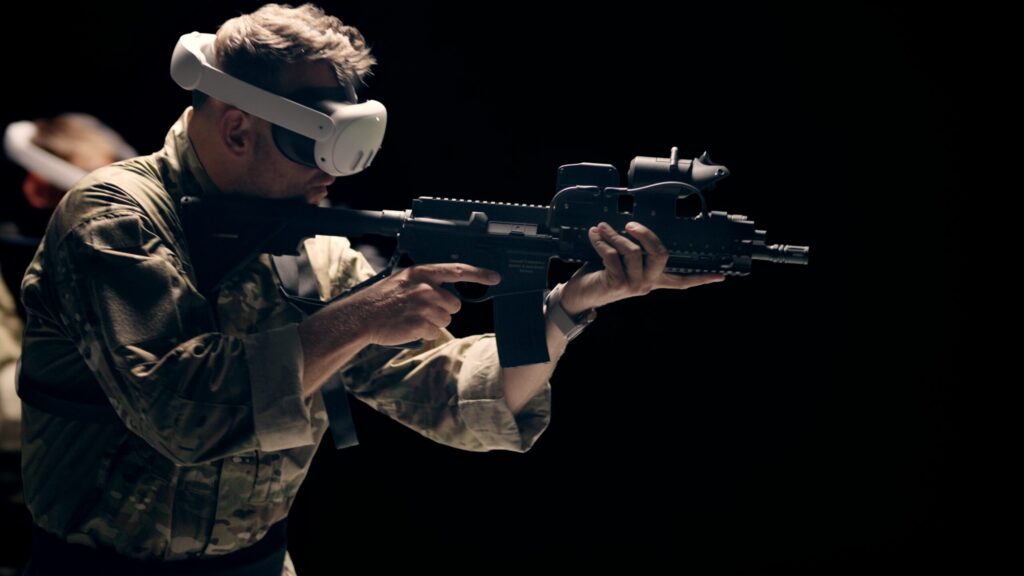
It continues with instructor time. Automating the fundamentals removes part of the day that was never really teaching, so one instructor can guide roughly 2.5× the trainees on the basics, and spend the time saved on the coaching only a person can give.
More repetitions only matter if they’re the right repetitions. On-demand access enables short, frequent training sessions instead of infrequent range weeks. It’s the same logic behind spaced repetition in any skill that decays without practice.
Every session passively generates objective performance data, offloaded whenever there’s connectivity. Analysed at force-wide level, that data surfaces lessons that can be encoded directly into the next software update and pushed back to the field: a system that improves continuously, not once every few years.
This spans foundational individual warfighter skills up to small-unit level: shoot, including counter-UAS; move, communicate, and medicate and drone piloting.
First close the loop, then speed it up
The bottom line is: a warfighter should be able to receive an updated skill pack every six to eight weeks to keep up with changes in technology, threats, tactics and lessons identified. This is exactly what capability-as-a-service enables: a continuous loop for building, updating and sustaining readiness.
And it’s available off-the-shelf today. Start now, instead of spending a year writing a program of requirements.
This artice accompanies the keynote at the Training & Education Conference of the German Federal Armed Forces in Hamburg at Sept, at 1st, 2026. “Rebuilding the Infrastructure of Readiness”, download it here